Jack’s Landing Paves The Way With New Zealand’s First Recycled Tyre Footpath
STORY ORIGINALLY PUBLISHED ON WAIKATOTIMES.CO.NZ – WRITTEN BY MADELEINE POWERS ON 17/09/25
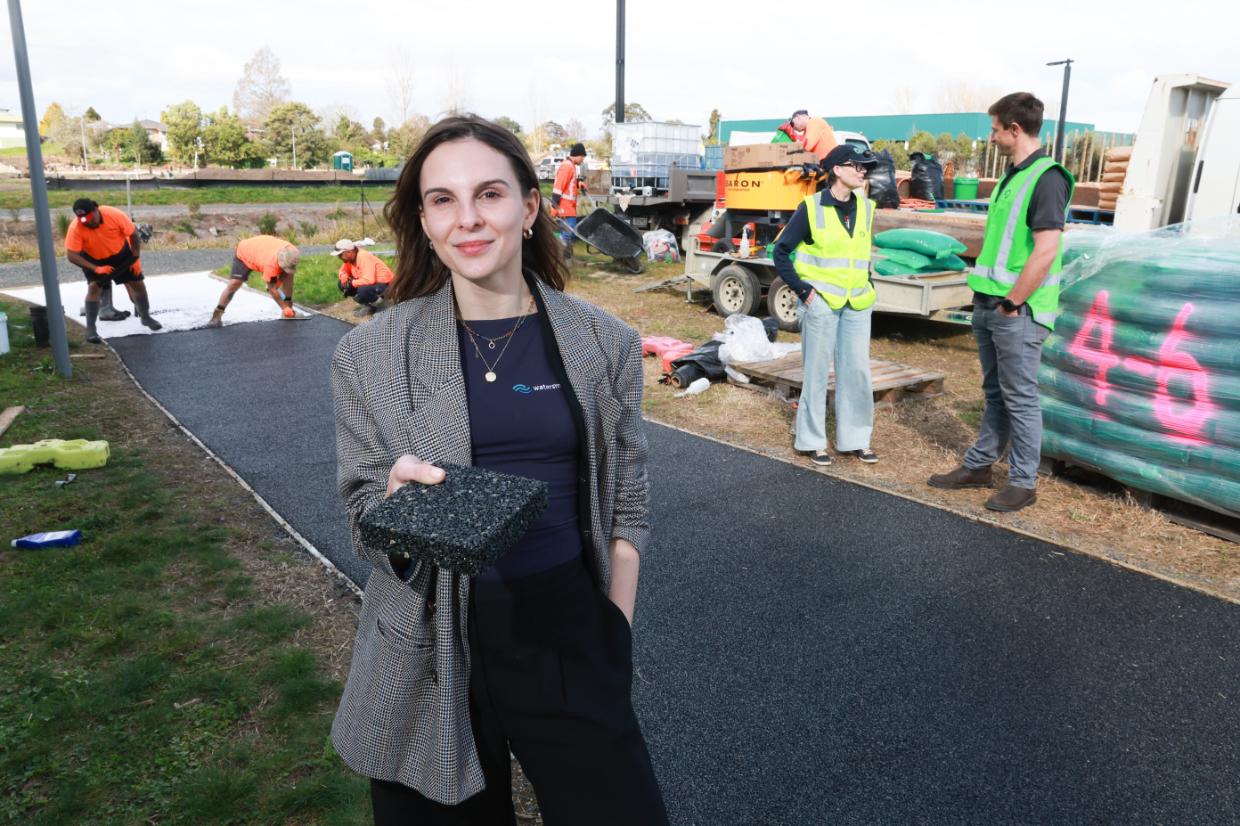
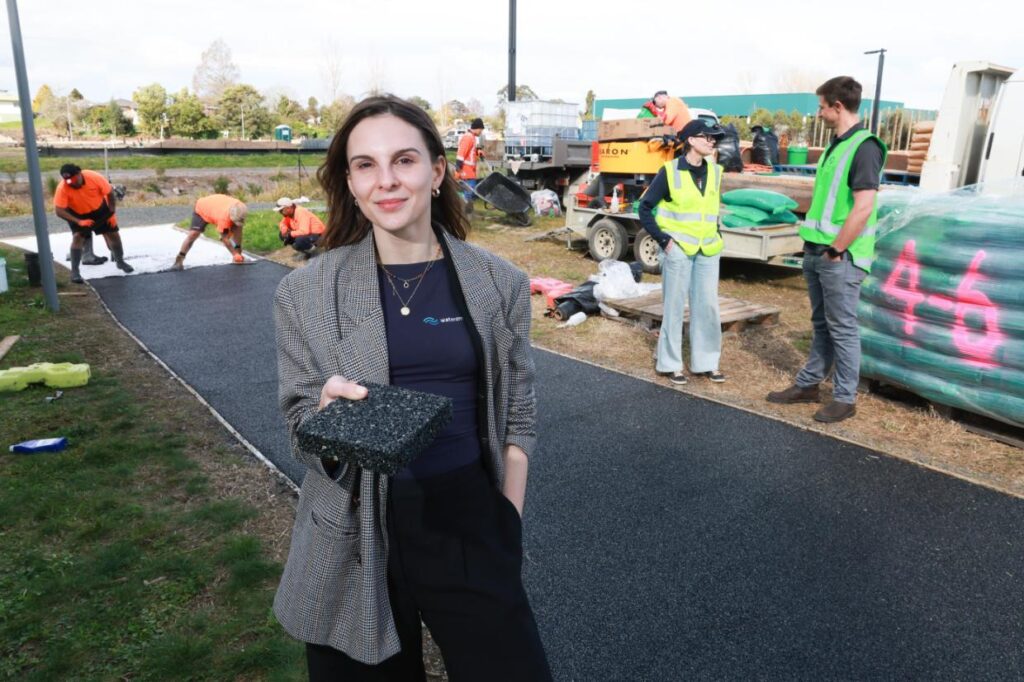
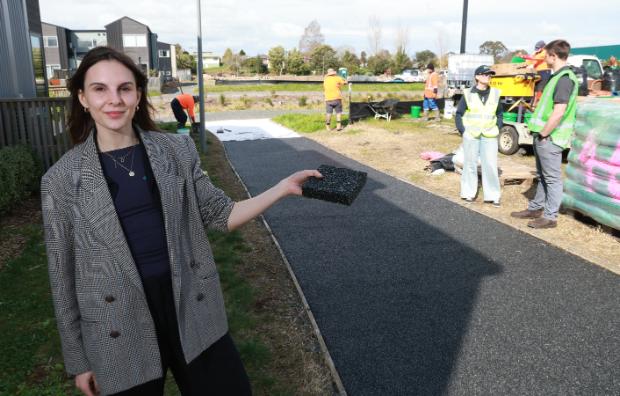
LEAD IMAGE: Klaudia Matyjas shows off a sample tile of the footpath product. [image MARK TAYLOR / WAIKATO TIMES]
Jack’s Landing has become the first in the country to go green with footpaths made of recycled tyres.
Contractors were on site at the Hamilton subdivision on Wednesday laying 207 square metres of Porous Lane, a rubberised paving developed by the University of Melbourne and brought to New Zealand in May by Water Smart.
A small test patch went down first to test the mixer, Water Smart business development manager Klaudia Matyjas said.
“Since May we’ve been optimising and figuring out how the supply chain will work.”
It’s the first installation in the country and a “big milestone” for the Australian-based company.
The rubber comes through Cambridge-based Treadlite under the nationwide Tyrewise scheme.
Blake Richardson is executive director of Treadlite, which processes the tyres, and also a director of Jack’s Landing.
Treadlite began with a mission to tidy up Cambridge but has grown into one of the biggest tyre recyclers in the country, collecting tyres from Bombay to Wellington and across both coasts of the North Island.
Matyjas said Treadlite sent samples of rubber crumb to the University of Melbourne lab to check the mix, and the paving has since been refined for New Zealand conditions.
She described Porous Lane, which is more expensive than your usual footpath, as a “premium product”.
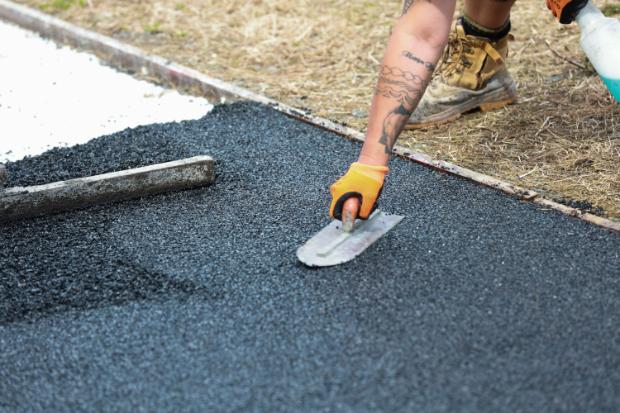
Porous Lane footpaths are more permeable than normal footpaths, allowing water to soak into the ground. [image MARK TAYLOR / WAIKATO TIMES]
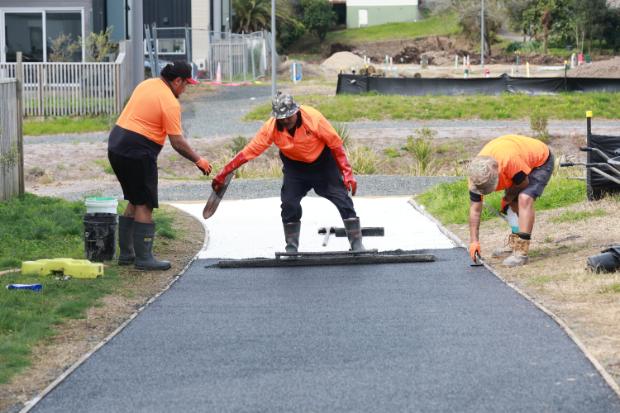
Contractors lay the Porous Lane footpath at Jack’s Landing. [image MARK TAYLOR / WAIKATO TIMES]
“All the water will go all the way through to replenish the groundwater table and not overload the storm system,” she said.
“It’s quite important to implement something that helps with water management, and this is just the easiest way to do it — to integrate it into infrastructure that’s already there or being built, like footpaths.”
The mix cures in around 8 to 12 hours, has a 25-year design life and, when you walk on it, “it’s a little bit more bouncy than concrete.”
“It doesn’t crack, it’s easy to maintain.”
Each square metre can use up to three tyres, and at the 40mm thickness used at Jack’s Landing the team calculated it was roughly the equivalent of 170 passenger tyres.
Truck tyres are preferred over car tyres for the product because they have higher quality rubber without fibre.
“Car tyres use a lot of fibre,” Richardson said, which would soak up a lot of the resin used in the product.
Matyjas said councils are showing strong interest, particularly for tree pits and other sites where roots can heave up conventional paths.
She said the pavement’s high porosity — about 40% — and contaminant capture are part of the appeal.
University of Melbourne studies show the paving entraps pollutants, preventing them from washing into the environment.
“Those pollutants never make it back to the system if you maintain it properly.”
Speirs says the product has been popular with council projects in Australia, and has even been used for cycle ways. [image MARK TAYLOR / WAIKATO TIMES]
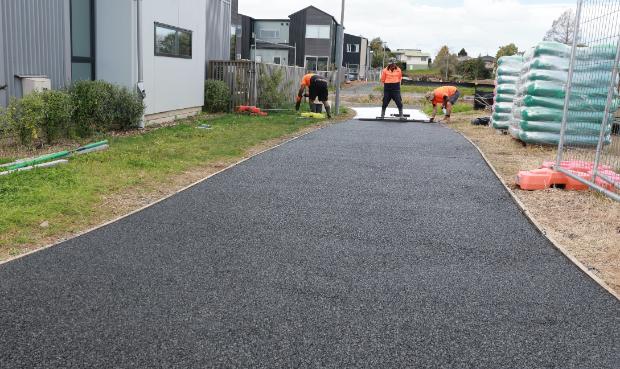
Managing water to prevent flooding is becoming a priority for developers and councils. The Porous Lane enables water to drain through. [image MARK TAYLOR / WAIKATO TIMES]
Tyrewise marketing and communications manager Kiri Speirs said the product stewardship scheme grew from the tyre industry pushing for regulation.
“Only around 40% of the tyres were being recycled, and the rest were being stockpiled, landfilled or illegally dumped.”
About six million tyres per year come to end of life in New Zealand, she said, and Tyrewise has been collecting since September last year.
Speirs said the goal is ambitious.
“We have a goal of using 80% of the tyres onshore by our fourth year of operation… so there needs to be lots more innovation and collaboration with businesses to get that happening.”
Researchers in Canterbury are testing rubber in building foundations to improve earthquake resilience.
“Melbourne University came up with this [Porous Lane], but who’s to say New Zealand can’t come up with something we could be selling to the world?”